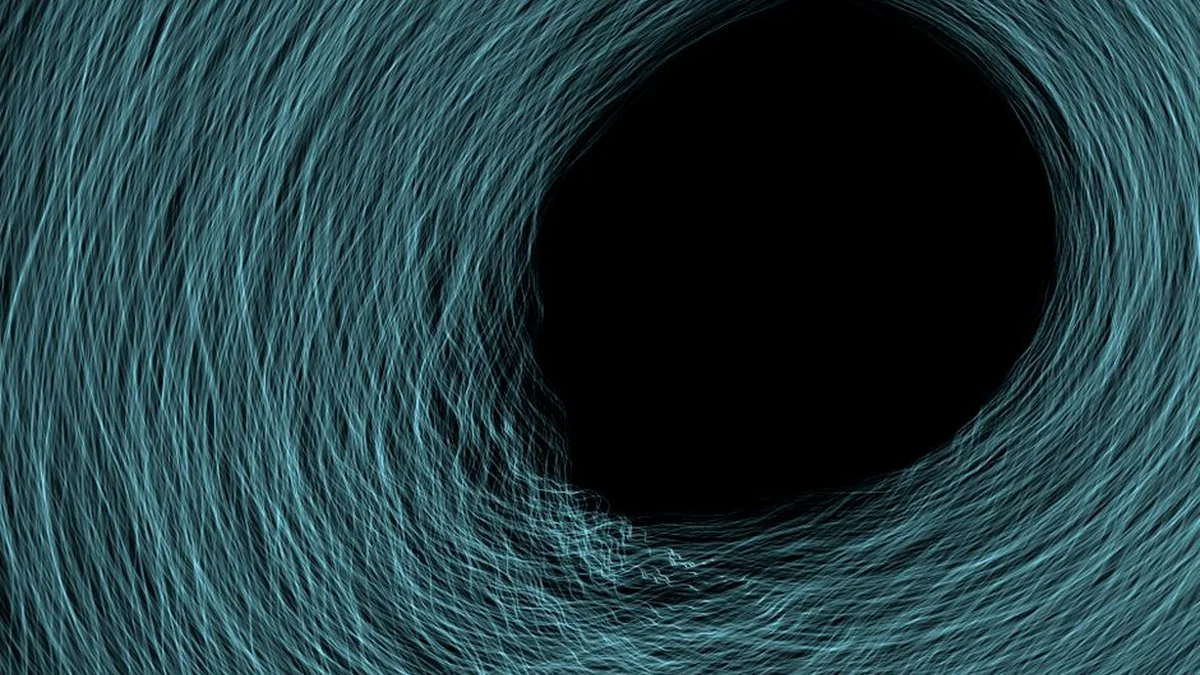
Interstellar space functions similarly to a constantly flowing body of water, but instead of liquid, it contains vortices of ionized gas that curve light. These gas structures have not been directly measurable until a breakthrough published in May 2026. A team led by Alexander Plavin from the Harvard & Smithsonian Center for Astrophysics revealed the first direct image of this space turbulence, which concurrently offered an explanation for the often impressionistic appearance of images taken of black holes.
The investigation centered on the distant quasar TXS 2005+403, located in the constellation of the Lark, approximately 10 billion light-years away. To achieve this unprecedented view, Plavin’s team dedicated nearly a decade to analyzing archived data collected between 2010 and 2019. Their data sources included a network of ten radio telescopes situated across the United States, operating across frequencies ranging from 1 to 5 GHz.
This research provides critical insight into the environment surrounding massive gravitational objects. The detection of this pervasive gas turbulence helps explain why current visualizations of a black hole can appear so abstract. The way light is warped by these unseen, flowing gas currents significantly affects observational data.
Consequently, the findings suggest that understanding the interstellar medium is crucial for accurately interpreting images of black holes. The study marks a significant step in astrophysics, providing a physical mechanism that accounts for the distortions previously observed when imaging the extreme environments near a black hole.
Topics: #why #black #hole